


The new rainbow mountain in Peru or Pallay Punchu de Apu Tacllo mountain (also called Sharp Mountain of Colors or Pallay Ponchu Mountain or condor sayana) is one of the new tourist destinations in Cusco that was shown to the world in a touristic way in the midst of the coronavirus pandemic. This natural destination, is one more option to complement your trip to Machu Picchu.
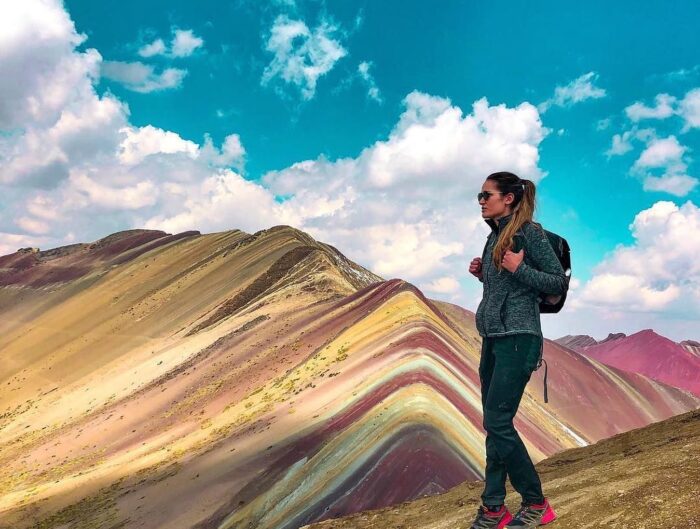
Located more than 194 kilometers from the city of Cusco, at an altitude of 4,791 meters. It is a large mountainous formation dyed in various shades as a result of the complex combination of minerals. The slopes and summit stand out in various colors including red, rosy, purple, green, pink, white, and others. Since 2020, this place has also begun to receive national and foreign tourists.
With this new natural destination, we would have 3 rainbow mountains in Cusco and close to Machu Picchu: The mountain of 7 Vinicunca colors that is close to the snowy Ausangate, the palccoyo mountain and the new rainbow mountain of Pallay Punchu.

Pallay Punchu del Apu Taqllo
Summary
Important facts about the new rainbow mountain
- Hiking time: 3 hours one way and the return approximately 2 hours.
- Maximum altitude: 4700 meters.
- Height of the beginning of the hike: 3720 meters.
- Distance: 8 km.
- Difficulty: Medium to challenging.
- Entrance fee: 10 soles.
- Horse rental: 80 soles.
Why is it called Pallay Punchu?
According to various anthropological investigations carried out in the district of Layo, the closest town to this new rainbow mountain, the multicolored tones of the mountain resemble the ponchos used in the Peruvian Andes. Pallay in Quechua means design or drawing and Puncho is the name of a male garment that the Andeans use to cover their torso.

Pallay Puncho – Traditional Andean clothing
How was Pallay Puncho mountain formed?
In order to explain the formation of this new rainbow mountain we have to go back to the Mesozoic era, that is, about 250 million years ago. When the earth’s crust was in formation and the different types of minerals, earth and sand were cemented layer upon layer, each one falling by its own weight on a certain geographical region (this depends on a lot of causality and luck, mother nature is wise and beautifull).
Later, when the South American and Nazca tectonic plates collided, this caused all the sediment to break, thus turning over and forming mountain ranges, hills and slopes, displaying the strata vertically and also over time with the winds, the Rain and all the other weather events caused the minerals to oxidize and turn into sulfates so that today it can be appreciated the way it is.
Why is the mountain colored?
The colors of the Pallay Punchu Mountain of Apu Tacllo are due to its mineralogical composition: the pink color is due to red clay, fangolitas (mud) and arilitas (sand). The whitish, due to the white quartz sandstone. The browns, browns and purples, due to siltstones and marls, rich in calcium carbonate.
The red is composed of claystones (exidated iron) and clays belonging to the upper tertiary. The green color is due to the compound of phyllites and clays rich in ferromagnesian (copper). The earthy brown is the product of the fanglomerate composed of rock with manganese belonging to the Quaternary era. And the mustard yellow color due to the calcareous sandstones rich in sulphide minerals (sulphide iron).

Apu Tacllo in Layo
Where is the Mountain of Pallay Puncho?
This new rainbow mountain is located in the Andes of Peru, in the Cusco region and very close to Machu Picchu. It belongs to the Langui Layo district, which calls it the “Pallay Punchu del Apu Tacllo”. The photos and videos that local people and some photographers and explorers posted on Facebook made this new rainbow mountain gain popularity. Since 2020 it has been a new tourist attraction in Cusco visited by local, national and little by little foreign travelers.
When was Pallay Poncho Mountain discovered?
It was not discovered, Pallay Puncho became known and viral in April 2020 in the midst of the coronavirus pandemic. On April 23, Mr. Tony Ccalta went to collect the medicinal plant (Sasawi) for his parents at Cerro Pallay Poncho and was surprised by the beauty of the place. He began to take photos and record videos, which he posted on Facebook and they went viral.
The use of Sasawi as a medicinal plant is recommended by the inhabitants of the area for diseases that affect the respiratory tract. Local people currently use it to counteract some of the discomforts of covid 19.
What is the best time to go to Pallay Poncho?
The best time to visit this new rainbow mountain is in the dry season (April to November), when rainfall is less likely. If you want to visit during the rainy season (December to March), bring a rain poncho and keep in mind that a clear day will depend on luck.
For which public is this new rainbow mountain ideal?
This natural attraction is ideal for all lovers of adventure tourism, lovers of nature and mountains. The recommended age is from 10 to 50 years.
Difficulty
The hike of 4 or 5 hours (depending on the physical state of the walker) is not dangerous, however it requires a moderate-high physical effort. There are sections of steep slopes up and down. However, one of the biggest difficulties is the cold weather and icy wind. The altitude of the area can cause altitude sickness. What is recommended by the experts is 3 days in the city of Cusco to acclimatize.

Pallay Punchu trail
How to get to this new rainbow mountain of Pallay Punchu from Cusco on your own?
First of all, you have to know that there are two enabled routes to the Pallay Punchu Mountain of Apu Tacllo. The first is through the District of Layo and the second route is through the town of Occobamba.
We recommend the Layo route, the walk is longer, however it does not have as much climb as going through the Occobamba route. This will allow you to enjoy the view of the mountains and the Langui Layo lagoon in a more pleasant way.
Route 1: Cusco – Sicuani – Layo
Due to its location, just over 194 kilometers from the city of Cusco, you must take a bus to Sicuani from the city of Cuzco (3 hours away). Head towards Av. Wayruropata and as a reference is, the Garcilazo de la Vega stadium, right there will be the vans that cover the Cusco – Sicuani route. The ticket is 10 soles. Once there, you have to take a bus to the district of Layo (1 hour away), where the walk begins to reach the Mountain of Pallay Poncho de Apu Tacllo. The hike along this route is approximately 4 hours round trip. The ascent is difficult but worth it.
Travel Cost
- One-way ticket Cusco – Sicuani: 10 soles
- One-way ticket Sicuani – Layo: 5 soles
- Return ticket Sicuani – Cusco: 10 soles
- Return ticket Layo – Sicuani: 5 soles
- Entrance to Pallay Punchu: 10 soles
- Local Breakfast in Sicuani: 5 soles
- Lunch: 10 soles
Route 2: Cusco – Sicuani – Marangani – Occobamba
If you go the second route, you have to take a taxi from Sicuani to the town of Occobamba where the walk begins. If you are going to do this route on foot, it is advisable to have good physical condition and be acclimatized to the altitude, otherwise do the route by renting horses. The hike along this route is 5 hours round trip at a moderate pace.
Travel Cost
- One-way ticket Cusco – Sicuani: 10 soles.
- Sicuani – Occobamba one-way ticket: 4 soles.
- Return ticket Sicuani – Cusco: 10 soles.
- Return ticket Occobamba – Sicuani: 4 soles.
- Entrance to Pallay Punchu: 10 soles.
- Local Breakfast in Sicuani: 5 soles.
- Lunch: 10 soles.
How to go to the Sharp Mountain of Colors Pallay Punchu of Apu Tacllo with a travel agency?
Not sure about visiting this new rainbow mountain on your own? You can also do it by hiring the services of a travel agency. On the internet or in the city of Cusco there are some travel agencies that offer the 1-day tour to the Pallay Punchu Mountain of Apu Tacllo. Tours include private transportation to the Layo district, food, entrance fees, and hiking guides. The beginning of the tour is with the pick-up of each tourist at the door of their hotel. The tours for the Pallay Punchu of Apu Tacllo start in the city of Cusco at dawn (3 or 4 a.m.) and end at night in the same place (6 or 7 p.m.).
Book here your tour with an authorized travel agency.
The weather
The climate in this new rainbow mountain is typical of the high Andean areas, it is cold, windy and dry. Rain, wind and altitude sickness can be the biggest obstacles for walkers. During the dry season from April to October, the Andean climate is similar to the desert. Daytime temperatures are 26 to 28 degrees Celsius and drop dramatically at night, usually to below 0 degrees Celsius.

Vicuñas in the Chaku ceremony
Flora and fauna
The incredible geography of this new rainbow mountain is adorned with animals typical of high Andean areas, such as deer, vizcachas, alpacas, llamas and vicuñas. The villagers in the area raise horses to offer as transportation to visitors. Due to the height of this region, the «ichu» or natural grass of the Andes and the Yareta is everywhere.

You might also like






Leave A Reply