


Summary
What is the Great Cave and Where is it Located?
The Great Cave is an Inca ceremonial temple built inside a natural cavern on the north side of Huayna Picchu, roughly halfway down from the summit into the valley. Archaeologists officially call it the «Temple of the Moon» due to theories about its possible use in ceremonies related to lunar cycles, although this name is speculative and not historically confirmed.
What is extraordinary about the Great Cave is how the Incas transformed a natural geological formation into an elaborate ceremonial space. They carved perfectly symmetrical trapezoidal niches into the rock walls, constructed a central altar with finely worked stones, and created a system of multiple interconnected chambers that demonstrate sophisticated architectural planning. The precision of the stonework inside this cave rivals the finest constructions of Machu Picchu itself.
The location of the Great Cave is deliberately remote and hidden. It is not visible from the main citadel, it does not appear on standard tourist routes, and it requires a significant additional hike to reach. This relative inaccessibility was likely intentional: the Incas reserved certain sacred spaces for ceremonies exclusive to the priestly elite, far removed from the public areas of the city.
Why the Great Cave Is So Special
The Great Cave is in an exceptional state of preservation precisely because few visitors know about it or reach it. While the main structures of Machu Picchu suffer wear and tear from millions of footsteps each year, this hidden temple remains virtually untouched, displaying architectural details and construction techniques with the same clarity they had 500 years ago.
The stonework inside the Great Cave is absolutely extraordinary. The niches carved into the living rock have the characteristic Inca trapezoidal shape, with precise angles and perfectly smooth surfaces. Some niches have internal subdivisions, creating spaces within spaces for ceremonial purposes that we can only speculate about. The stone was worked with such mastery that it appears polished, reflecting light in ways that create ever-changing atmospheres depending on the time of day.
The central altar of the Great Cave is particularly impressive. Constructed from finely carved granite blocks fitted together without mortar, it demonstrates the same precision as Machu Picchu’s most celebrated constructions. Some blocks have carved protrusions that likely served to tie offerings or hold ceremonial objects during rituals. The exact function of the altar remains a mystery, fueling speculation about Inca religious practices.
The atmosphere inside the Great Cave is palpably different from the rest of Machu Picchu. The natural dimness, the constant humidity, the echo of dripping water, and the feeling of being inside the mountain itself create an almost mystical experience. Many visitors report intense feelings of reverence, spiritual connection, or simply awe at this sacred space that has remained virtually unchanged for centuries.

The Great Cavern holds ceremonial secrets that few tourists discover, hidden in the bowels of Huayna Picchu.
How to Access the Great Cave
Visiting the Great Cave requires the same ticket as your Huayna Picchu ticket, as the trail to the temple branches off from the main mountain path. This means you must book 3-4 months in advance and pay the same premium price as for climbing Huayna Picchu. However, your ticket grants you access to both: the summit of the mountain AND the Great Cave on the same visit.
Access to the Great Cave is via a trail that branches off the main Huayna Picchu path approximately 20 minutes after beginning the ascent. Signs indicate «Temple of the Moon,» pointing to a side trail that descends the mountain’s north slope. This detour adds approximately 1.5-2 hours to your total Huayna Picchu hike.
Understanding the time management is absolutely crucial. If you plan to visit both the summit of Huayna Picchu and the Great Cave, you’ll need approximately 4-5 hours total: 1 hour climbing to the summit, 30 minutes at the top, 45 minutes descending to the junction, 45 minutes descending into the Great Cave, 30 minutes exploring the temple, and 1 hour climbing back up to the main trail and descending to Machu Picchu. It’s physically demanding but entirely doable for people in good physical condition.
Some visitors choose to visit only the Great Cave without climbing to the summit of Huayna Picchu. This strategy makes sense if your priority is archaeology over panoramic views, if you have time constraints, or if you want to conserve energy. The trail to the cave, while long, is less technical and daunting than the vertical stairs to the summit, making it a more accessible option for people with moderate vertigo.
The Trail to the Great Cave: What to Expect
The trail descending into the Great Cave is an experience in itself. It winds through the cloud forest on the northern slope of Huayna Picchu, a lush ecosystem rarely seen by tourists who stick to the main Machu Picchu circuits. The vegetation is dense, with giant ferns, wild orchids, hanging bromeliads, and moss-covered trees creating an atmosphere of primeval jungle.
The first 20-30 minutes of the descent to the Great Cave are steep, with uneven stone steps. Be careful, as the stones can be wet and slippery from the constant humidity of the cloud forest. Trekking poles are useful here for maintaining balance and reducing pressure on your knees during the long descent.
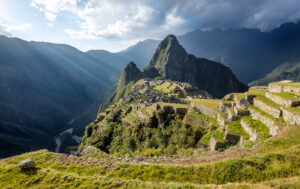
As you descend toward the Great Cave, the occasional views of the Urubamba Valley thousands of meters below are spectacular. At certain points, you can see the river snaking like a silver ribbon at the bottom of the canyon. The feeling of being suspended on the vertical side of a mountain, surrounded by dense jungle, with dramatic precipices at your side, is simultaneously exhilarating and humbling. The trail eventually reaches an area with several smaller Inca structures: small terraces, retaining walls, and what were likely support structures related to the Great Caverna ceremonial complex. These secondary ruins rarely appear in photographs or guidebooks, but they are fascinating in their own right, demonstrating just how extensive the religious complex surrounding the main temple was.
Finally, after about 45 minutes of descent, you reach the entrance to the Great Caverna. The first impact is visual: a dark opening in the living rock with Inca structures clearly visible inside. The transition from the bright light outside to the cool gloom of the cave requires a moment for your eyes to adjust, adding drama to the experience of entering.
Exploring the Interior of the Great Cave
The interior of the Great Cave consists of multiple interconnected chambers that the Incas adapted and modified from the cave’s natural formation. The main chamber is the most impressive, approximately 10 meters deep, with walls carved with ceremonial niches, and a central altar that dominates the space. The ceiling height varies, creating intimate spaces and more expansive areas within the same complex.
The trapezoidal niches carved into the walls of the Great Cave demonstrate the Inca obsession with symmetry and precision. Each niche is exactly the same shape, with sides that taper upward, following the standard Inca architectural design that helped structures withstand earthquakes. Some niches have internal subdivisions, possibly to hold specific ceremonial objects or offerings during rituals.
The natural lighting inside the Great Cave changes dramatically depending on the time of day. Sunlight enters obliquely through the main opening, creating beams that selectively illuminate certain areas while leaving others in deep shadow. This interplay of light and shadow likely held ceremonial significance, with specific times of day or year when the light struck precise points within the temple, similar to the Temple of the Sun at Machu Picchu.
Water plays a constant role in the atmosphere of the Great Cavern. Drops continuously fall from the cave ceiling, creating a rhythmic sound amplified by the natural acoustics of the enclosed space. Small pools form in depressions in the rocky floor, reflecting the dim light and adding to the feeling of being in a living, sacred space. The Incas likely incorporated this aquatic element into their ceremonies.
A second, smaller chamber is accessed from the main one, venturing deeper into the mountain. This area is darker, more humid, and possesses a distinctly different energy. Some visitors find this inner chamber more haunting or spiritually intense. Theories suggest it may have served for initiation rituals or particularly secret ceremonies reserved only for the highest-ranking priests.
Theories on the Purpose of the Great Cavern
Archaeologists and historians have debated the exact purpose of the Great Cavern for decades. The most popular theory, which gave it the alternative name «Temple of the Moon,» suggests that it was a ceremonial space dedicated to the moon or to female deities associated with night, water, and the underworld. This theory is based on Inca symbolism that associated caves with Pachamama (Mother Earth) and the Ukhu Pacha (underworld).
Another theory proposes that the Great Cavern served as a mausoleum or mummification site for high-ranking nobles or priests. The niches carved into the walls could have held funerary bundles, and the remote location within the sacred mountain would be appropriate for an elite burial space. However, no human remains or definitive archaeological evidence have been found to confirm this theory.
A third interpretation suggests that the Great Cavern was a specialized astronomical observatory. The orientation of the cave, the angles of the niches, and how light penetrates the space at specific times could have allowed astronomer-priests to track lunar cycles, eclipses, or particular celestial phenomena. This theory aligns with the sophisticated astronomical knowledge demonstrated in other constructions at Machu Picchu.
Regardless of its specific original function, there is a consensus among experts that the Great Cavern was a sacred space of significant importance. The quality of the stonework, the deliberately remote location, and the architectural complexity indicate that it was not a minor or utilitarian construction. Only ceremonies of the utmost religious importance would justify the investment of resources and effort required to create this temple within the mountain.

Best Time to Visit the Great Cave
Since the Great Cave is only accessible with a Huayna Picchu ticket, your timing options are determined by the two entry groups: 7:00-8:00 AM or 9:00-10:00 AM. To maximize your experience in the cave specifically, Group 1 (7:00 AM) has significant advantages. Starting early gives you ample time to visit both the summit of Huayna Picchu and the Great Cave without time pressure.
The lighting inside the Great Cave during the mid-morning hours (9:00-10:00 AM) is particularly beautiful. The sun is high enough to penetrate deep into the cave, creating dramatic light and shadow effects that are ideal for photography. However, Group 2, which starts at 9:00-10:00 AM, leaves you with a tighter timeframe if you want to visit both destinations.
A smart strategy for visitors particularly interested in the Great Cave is to take Group 1, ascend directly to the summit of Huayna Picchu first while you have fresh energy, and then, on the descent, stop at the turnoff for the Great Cave. This allows you to enjoy both destinations without excessive fatigue, and you arrive at the cave around 9:00-10:00 AM when the light is optimal.
For serious photographers, consider that the Great Cave requires your camera’s ability to handle low-light conditions. A lightweight tripod is useful, although it can be cumbersome to carry during the trek. Headlamps or portable lamps allow you to selectively illuminate specific architectural details you want to highlight in your photographs.
Essential Preparation for the Great Cave
Physical preparation for visiting the Great Cave should include everything required for Huayna Picchu plus additional considerations. The extended descent to the cave and the subsequent ascent back are physically demanding, especially after having already climbed to and from the summit of Huayna Picchu. Your legs will accumulate significant fatigue, so prior training focused on leg endurance is crucial.
Pack strategically for a 4-5 hour hike. You’ll need more water than usual (at least 2-3 liters), more energy snacks, and probably a light meal like a sandwich or fruit. Don’t underestimate how much energy you’ll expend during this extended adventure. Dehydration and low blood sugar will ruin your experience and can be dangerous at these altitudes.
A headlamp or flashlight is highly recommended for properly exploring the Great Cave. Although there is natural light, the interior chambers are dark, and many architectural details are invisible without supplemental lighting. A light allows you to examine deep niches, study the stone carving techniques, and simply navigate the space safely.
Mentally, prepare for a long and physically demanding day. Combining Huayna Picchu with the Great Cave is likely the most demanding day you’ll have on your entire trip to Peru. However, it is also potentially the most rewarding, offering experiences that very few tourists get: the dramatic summit of the most iconic mountain AND the most mysterious secret temple, all in one epic adventure.

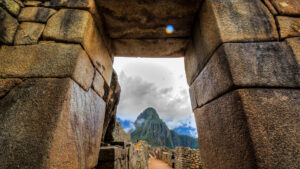
The perfectly carved niches in these rock walls demonstrate architectural mastery that rivals any construction at Machu Picchu.
Why the Great Cave is Worth Visiting
The Great Cave offers something that almost no other site in Machu Picchu can provide: genuine solitude in one of the world’s most visited tourist destinations. While thousands of people crowd into the main citadel each day, you will likely have the cave entirely to yourself or share it with only a handful of other visitors. This tranquility allows for a deep connection with the space that is impossible in crowded areas.
For archaeology enthusiasts, the Great Cave is a must-see. It represents one of the best-preserved examples of how the Incas adapted natural formations for ceremonial purposes, a central practice in their worldview that considered all geological formations as huacas (sacred places). Studying this integration of nature and architecture profoundly enriches your understanding of the Inca civilization.
The photographic experience in the Great Cave is unique and challenging. The lighting conditions are completely different from anywhere else in Machu Picchu, requiring specific techniques but rewarding you with dramatic and original images. The photographs you capture here will be truly unique, not the same replicated images that all tourists get from the main viewpoints. Emotionally and spiritually, many visitors report that the Great Cave is the highlight of their visit to Machu Picchu. There is something profoundly moving about being inside an ancient sacred space, in the dimness of a cave carved by Inca hands five centuries ago, feeling the same humidity and hearing the same sounds of dripping water that the priests heard during their ceremonies. It is a connection to the past that transcends mere tourism.
Conclusion
The Great Cave represents the ultimate reward for travelers willing to go beyond the standard tourist circuits, willing to invest extra physical effort, and willing to investigate more deeply than the superficial guidebooks. In a world where Machu Picchu has become synonymous with mass tourism, this hidden temple remains as a reminder that there are always deeper secrets waiting to be discovered by curious and determined explorers.
If your physical condition allows you to take on the challenge of Huayna Picchu, if you can dedicate the necessary 4-5 hours, and if you value authenticity over convenience, then visiting the Great Cave should be a non-negotiable part of your itinerary. It’s the difference between visiting Machu Picchu and truly exploring it, between being a tourist and being an adventurer, between seeing what everyone else sees and discovering what almost no one discovers. The secret temple in the heart of the sacred mountain awaits you, ready to reveal mysteries that will completely transform your understanding of the most famous Inca wonder of the Peruvian Andes.





Leave A Reply