


The flowers in Machu Picchu often go unnoticed by tourists. The Inca citadel, in addition to its beautiful shrines and houses, has around 450 varieties of flowers of various shapes, sizes and colors. The Inca citadel of Machu Picchu is located in a geographical area, known as the cloud forest. Specifically, it is located at an altitude of 2,400 meters, between the last Andean foothills and the beginning of the Amazon jungle. The average temperature in Machu Picchu is 25 degrees Celsius and the rainfall is 2300 cubic millimeters per year; These characteristics make the Inca citadel have a great biodiversity of flora and especially flowers.
Summary
The most emblematic flowers in Machu Picchu
I AM THAT FLOWER
Your life is a great river, it goes fast.
On its shore, invisible, I sprout sweetly.
I am that flower lost between reeds and achiras
How pious you feed, but perhaps you don’t even look.
When you grow up, you drag me down and I die in your bosom;
when you dry, I die little by little in the silt;
but again I sprout sweetly
when on beautiful days you go mightily.
I am that lost flower that blooms on your banks
humble and silent every spring.
Author of the poem: Alfonsina Storni
Begonia veitchii
Begonia veitchii, is a species of perennial plant belonging to the Begoniaceae family. It is native to South America.
Description
It is a herb found in the Yungas in Bolivia and Peru on the rocky slopes of the Andes Mountains at an altitude of up to 4500 meters. One of the places where it has the greatest predominance are the rocky mountains of Machu Picchu.
Etymology
Begonia: Generic name, coined by Charles Plumier, a French botanist, honors Michel Bégon, a governor of the former French Colony of Haiti, and was adopted by Linnaeus.
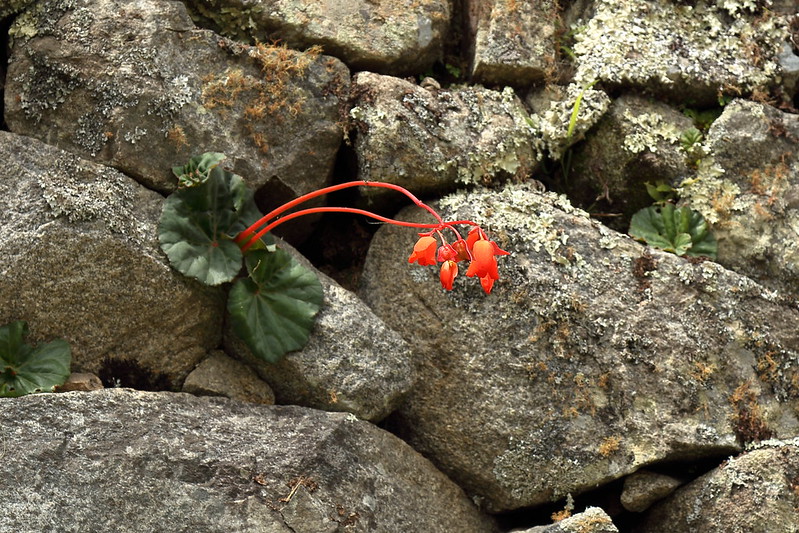
Begonia Vietchi
Masdevallia veitchiana
Masdevallia veitchiana is a species of orchid with terrestrial habits, sometimes lithophytic or rarely epiphytic, native to Peru; It lives exclusively in the cloud forest and is one of the emblematic flowers in Machu Picchu.
Description
It is a species of orchid of a large size, which prefers a cool climate, has terrestrial habits, sometimes lithophytes or rarely epiphytes. Flowering occurs in spring and early summer in an erect inflorescence 39-44 cm long, with long-lasting flowers up to 20 cm wide, appearing well above the leaves. The apparent uneven distribution of color in M. veitchiana is due to the presence of minute purple hairs on the sepals that give the flower a beautiful visual appearance. Viewed head-on with the light behind you, the color is symmetrical.
This species has orange flowers covered in a pattern of small purple hairs that create a kind of iridescence as the flower moves in the breeze. The flowers are very large, approximately 5 cm x 15 cm.
Distribution and habitat
It is found at an elevation of 2,000 to 4,000 meters around Machu Picchu in Peru on the steep rocky slopes covered with grasses and shrubs. The Quechua population gives it the name waqanki. «you cry» or «you will cry» in Quechua – in honor of Princess Cusi Qoyllur’s tears, which would be imprinted on the petals of each flower. It is rumored that it has been cultivated by the Incas for centuries.
Etymology
The plant was named in honor of Harry Veitch of Veitch Nurseries, whose plant he discovered in 1867.

Masdevalia Vietchiana
Sobralia dichotoma
Sobralia dichotoma, is a species of epiphytic orchid or occasional terrestrial habit. It is native to western South America to Venezuela.
Description
It is a large, corpulent, cespitose orchid, with stems with narrowly lanceolate to ovate-lanceolate, acuminate, rigid, chartaceous leaves: It blooms in a terminal inflorescence 20 cm long, dichotomously branched, racemose, with many flowers, the opening of the inflorescence is successive, the flowers are fragrant and fleshy and are produced in the summer and autumn.
Distribution and habitat
It is distributed throughout Colombia, Ecuador, Peru and Bolivia, in terrestrial ecosystems of open forests on granite outcrops, such as those that exist in Machu Picchu; grows in warm or cold water at elevations of 750-2800 meters.
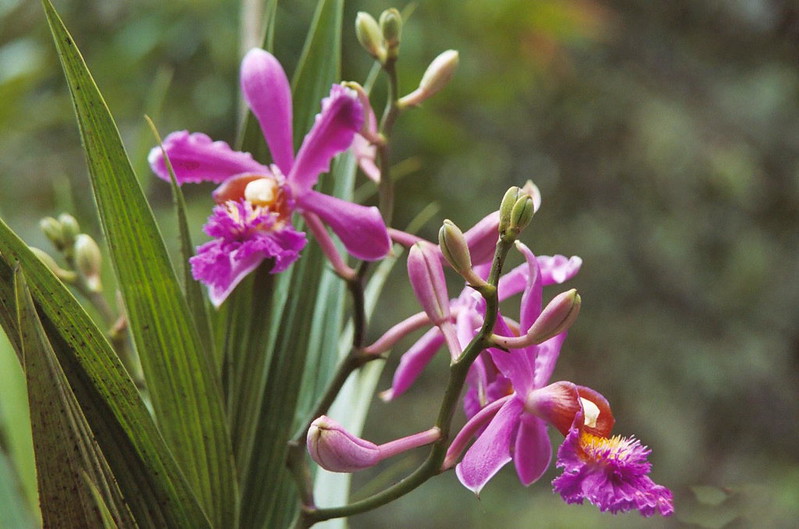
Sobralia Dichotoma
Epidendrum secundum
Epidendrum secundum, is one of the crucifix orchids, a little-known reed-stem species, which Dressler (1989) describes as «the Epidendrum secundum complex». According to Dressler, there are dozens of varieties. They can appear in shades of lilac, red, orange, yellow or white, and have a noticeable callus on the trilobed lip with fringes. The plant is quite cold and can tolerate a light frost.
Habitat
Epidendrum secundum is found in the montane forest of the Neotropics (up to 2600 meters elevation), including Cusco, southeastern Peru, and Brazil. They are also found in great abundance in the Wiñaywayna archaeological complex, an Inca citadel located 5 kilometers from Machu Picchu. The Epidendrums are called Wiñaywayna in Quechua and are also one of the most abundant flowers in Machu Picchu.

Epidendrum Secundrum
Brugmansia arborea
The floripondio, angel’s trumpet, campacho —among other common names— is a species of shrubby plant of the genus Brugmansia of the Solanaceae family. It is native to South America and grows wild in Central America as well, but it is naturalized or cultivated throughout the world. The IUCN has classified Brugmansia arborea as extinct in the wild. It is one of the flowers in Machu Picchu that still grows wild.
Description
It is a perennial or semi-evergreen shrub covered with a fine covering. It can reach 7 m in height. It has alternate leaves, oval in shape, with asymmetric blades at the base. The flowers, up to 17 cm, are subconical, with a corolla of 3-5 more or less acute lobes, aromatic, from white to ivory. The calyx, longitudinally split and persistent, is almost as long as the corolla tube.
Toxicity
As in the case of Datura, all the aerial organs of the Brugmansia species contain substances whose consumption can cause problems in human health. Specifically, they contain tropane alkaloids such as scopolamine and hyoscyamine, among others. Its ingestion, both in humans and in other animals, can be fatal since it has quite powerful hallucinogenic effects, far superior to other hallucinogenic plants. Simple contact with the eyes can cause mydriasis (pupil dilation) or anisocoria (asymmetry in pupil size).
cultivation and uses
It is used as an ornamental plant. It prefers semi-shade, especially in hot climates; It is sensitive to cold. Blooms very well in temperate climates in sheltered locations; requires rich, drained, cool and dry soil in winter. During the vegetative season it requires abundant and daily watering, providing some fertilizer.

Brugmansia Arborea
Calceolaria
Common name capachito, little shoes of Venus, topa-topa, or little shoes of the Virgin, is a genus of phanerogams in the family Calceolariaceae, sometimes classified by some authors in Scrophulariaceae. This genus of shrubs, lianas herbs, and its geographic range extends from Patagonia to central Mexico, with its center of distribution in the Andes region. It comprises 646 described species.
Calceolarias have flowers that are usually yellow or orange, and may have red or purple spots. This is one of the rarest flowers in Machu Picchu.
Etymology
Calceolaria: generic name that derives from Latin and means «shoemaker». The genus was described by Carlos Linnaeus and published in Kongliga in 1770.
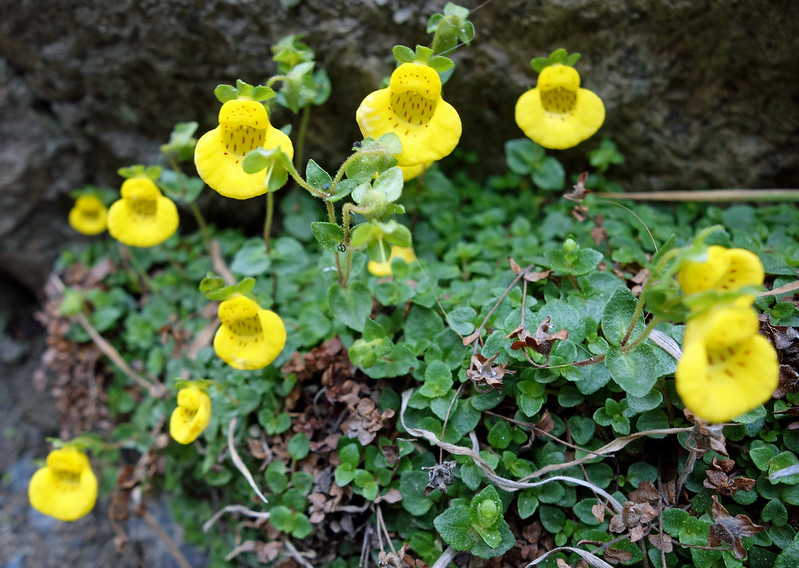
Santa Claus Shoes
There are around 450 flowers in Machu Picchu, of which around 100 can be seen on a 3-hour guided tour inside the Inca citadel. Also, if you have a planned trip to Machu Picchu, do not forget to consider in your activity plan to visit the Orchid Conservation Center, in addition to visiting places such as the «House of Butterflies», the Allcamayo Waterfalls and over all the flowers in Machu Picchu.

You might also like





Leave A Reply