


When planning your visit to Machu Picchu, one of the most exciting decisions is whether to include a climb up one of the mountains surrounding the Inca citadel. While Huayna Picchu gets all the fame, Machu Picchu Mountain (also called Machu Picchu Mountain) offers an equally spectacular experience, often superior in several ways. This guide will help you decide if this mountain is the right choice to complement your visit to the archaeological site.
Summary
What is Machu Picchu Mountain?
Machu Picchu Mountain is the peak that rises on the opposite side of Huayna Picchu, reaching an altitude of 3,082 meters above sea level. This means you’ll climb approximately 652 meters from the citadel, a significantly greater elevation gain than its more famous counterpart. The name can be confusing: it’s not the mountain on which the citadel sits, but rather a separate summit that offers unparalleled panoramic views of the archaeological complex.
This mountain was an integral part of the sacred Inca landscape. The ancient inhabitants of the citadel considered all the surrounding mountains to be apus (protective spirits), and they likely performed ceremonies and made offerings on their summits. Although it doesn’t have the same architectural structures as Huayna Picchu, the trail to the summit reveals agricultural terraces and some remnants of original Inca roads.
The experience of climbing this mountain is radically different from walking through the archaeological citadel. It’s a genuine mountain trek that temporarily disconnects you from the ruins to immerse you in the cloud forest ecosystem, offering a broader perspective of the natural environment the Incas chose to build their sacred city.

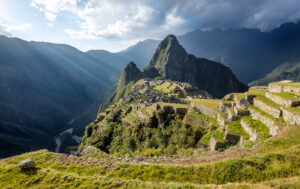
From the summit of this mountain, Machu Picchu unfolds like a perfect map, demonstrating why the Incas chose this sacred place.
Comparison: Machu Picchu Mountain vs. Huayna Picchu
The first question everyone asks is: Which mountain should I climb? The answer depends entirely on your priorities and abilities. Huayna Picchu is shorter (1-1.5 hours of ascent), more technical with dramatic vertical staircases, more exposed with intimidating precipices, and much more exclusive with only 200 daily slots that sell out months in advance.
Machu Picchu Mountain, on the other hand, requires a 1.5-2 hour ascent, follows a less technical zigzag trail, has less exposure (better for people with vertigo), and offers greater availability with 800 daily slots divided into two groups. The overall physical effort is greater due to the distance and elevation gain, but the technical difficulty is lower.
From the perspective of panoramic views, Machu Picchu Mountain is objectively superior. Being higher and farther from the citadel, you get a complete view of the archaeological site, the Urubamba Valley, Huayna Picchu in the foreground, and the Vilcabamba mountain range stretching to the horizon. It’s like seeing a three-dimensional map of the entire area versus the closer but limited view from Huayna Picchu.
For photographers seeking to capture the full scale of Machu Picchu within its geographical context, the mountain is unbeatable. You can photograph the entire citadel, including Huayna Picchu, in a single frame—something impossible from any other vantage point. Images captured from this summit possess an editorial quality that travel agencies and specialized media outlets constantly seek.
Difficulty Level and Physical Requirements
The hike to Machu Picchu Mountain is rated as moderate to difficult, primarily due to its duration and elevation gain, not technical difficulty. The trail is well-maintained, with stone steps on the steepest sections, though these are uneven in height and depth. There are no sections requiring the use of hands or presenting frightening exposure to precipices.
Physically, this mountain is more demanding than Huayna Picchu in terms of cardiovascular endurance. You will be hiking steadily uphill for 1.5–2 hours, which is equivalent to climbing approximately 130 stories of a building. Your legs, especially your quadriceps and calves, will be working hard. The descent, although faster (1–1.5 hours), puts significant stress on your knees and ankles.
Altitude is a critical factor. Starting at 2,430 meters at Machu Picchu and ascending to 3,082 meters, you will experience progressively thinner air. If you are not properly acclimatized, you will experience shortness of breath, dizziness, headaches, and rapid fatigue. It is recommended to spend at least two full days in Cusco (3,400 meters) before attempting this mountain to allow your body to adjust to the altitude.
There are no official age restrictions beyond the minimum of 12 years old, but you need to assess your fitness honestly. If you have heart problems, severe respiratory issues, knee or ankle injuries, or haven’t exercised regularly in months, this mountain will be extremely challenging. However, people in reasonable physical condition, including active seniors, successfully complete this climb every day.
How to Book Your Mountain Ticket
Tickets for Machu Picchu Mountain are significantly more affordable than those for Huayna Picchu. With 800 daily slots (400 per group), you can usually book 1-2 months in advance, even during peak season. The two entry groups are: Group 1 (7:00-8:00 AM) and Group 2 (9:00-10:00 AM), both with 4 hours allowed at the archaeological site.
To purchase your ticket, visit the official website of the Peruvian Ministry of Culture or work with an authorized travel agency in Cusco. The cost is approximately the same as Huayna Picchu: around 200 Peruvian soles (US$50-55) for adult foreigners. The ticket automatically includes access to Machu Picchu via Circuit 3 or 4, allowing you to explore the citadel before or after the climb.
It is essential that the information on your ticket exactly matches your passport. Park rangers strictly verify documents at the checkpoint before the climb begins. Any discrepancies will result in denied entry without a refund. Carefully check the spelling of names and document numbers at the time of purchase.
Tickets are non-refundable and non-transferable. If weather conditions are extremely dangerous, access to the mountain may be closed for safety reasons, but this is rare. Most days, even with light rain, the trail remains open. Plan your itinerary flexibly in case you need to reschedule due to illness or altitude sickness.
The Ascent: What to Expect on the Trail
The checkpoint to begin the ascent to Machu Picchu Mountain is located within the archaeological site, approximately a 25-30 minute walk from the main entrance. You must arrive promptly at your assigned time, as access control is strict. Park rangers will register your entry, noting your name and exact start time.
The first 30 minutes of the trail are relatively gentle, following a wide, compacted-earth path that winds through the cloud forest. This initial stretch allows you to warm up your muscles and establish your pace without pressure. The vegetation is lush: giant ferns, wild orchids, bromeliads, and moss-covered trees create a high-altitude rainforest atmosphere.
After this warm-up, the trail becomes considerably steeper. You enter a series of long switchbacks that steadily climb the mountainside. These switchbacks are designed to reduce the gradient, but you will still feel the effort with every step. The horizontal distance is deceiving: you walk much farther than it appears in a straight line due to the continuous turns. About halfway up, you’ll find an intermediate viewpoint with rustic wooden benches where you can rest. From here, the views of Machu Picchu are already breathtaking, showcasing the citadel from a high angle with Huayna Picchu rising dramatically behind it. Many people take a long break here, regaining energy for the final section of the mountain climb.
The last section to the summit includes steeper stone steps, and the path narrows considerably. The air feels thinner as you gain altitude, and each breath requires more effort. Your legs will begin to burn and possibly tremble slightly from the accumulated exertion. This is the section where your mental resolve will be tested as much as your physical stamina.
The Summit: Views That Justify All the Effort
Reaching the summit of Machu Picchu Mountain is a moment of absolute triumph and simultaneous awe. The summit area is relatively large compared to Huayna Picchu, with multiple rocky areas where you can sit, rest, and contemplate the views. The sense of accomplishment is overwhelming, especially when you look down and realize the distance you’ve climbed.
The panoramic views from this mountain are simply spectacular and surpass even the highest expectations. Machu Picchu unfolds like a perfect model directly below, allowing you to distinguish each sector, each temple, each plaza with absolute clarity. You can identify the Temple of the Sun, the Intihuatana, the Sacred Plaza, and mentally trace the routes you’ve walked or will walk.
Huayna Picchu rises majestically in front of you, allowing you to appreciate its characteristic conical shape from a perspective few get. You can see the trail zigzagging toward its summit and, with binoculars, even make out the small figures of people ascending. This view puts the entire geography of the historic sanctuary into context.
The Urubamba River meanders brightly thousands of meters below, tracing perfect curves through the deep valley. On clear days, you can watch the tourist train gliding like a toy along the tracks that follow the river’s course. The snow-capped peaks of the Vilcabamba mountain range stretch as far as the eye can see, creating a seemingly endless horizon.
The sensory experience at the summit of this mountain goes beyond the visual. The wind blows constantly at this altitude, carrying the fresh scent of the cloud forest mixed with pure mountain air. You might hear the calls of exotic birds that inhabit these high-altitude ecosystems, including, if you’re extremely lucky, the Andean condor.
Stay at the summit as long as you need. Most visitors linger for 30-45 minutes, resting, taking photos, eating energy snacks, and simply absorbing the magnitude of what they’ve just accomplished. There’s no rush: this is one of those defining travel moments that deserves to be fully savored before beginning the descent.
The Descent: Caution on the Return
Descending Machu Picchu Mountain requires just as much attention as the ascent, albeit for different reasons. Your legs will be fatigued from the effort of climbing, and now they must support your body weight as you steadily descend for 1-1.5 hours. Your knees absorb repetitive impact with each step, which can be painful if you have sensitive joints.
Trekking poles are particularly useful during the descent, helping to distribute weight and reduce pressure on your knees. If you didn’t bring poles, walking slowly and using nearby rocks or logs for occasional support is helpful. There’s no shame in taking the descent very slowly: safety is always more important than speed.
The trail stones can be slippery, especially in the stepped sections after morning rains or due to the constant humidity of the cloud forest. Place each foot intentionally, checking that you have a solid grip before transferring your weight. Accidents, though rare, occur more frequently during descents when fatigue impairs coordination and judgment. Once you return to the checkpoint, you will have completed approximately 3-3.5 hours of strenuous trekking. Your legs will be shaky, your clothes likely soaked with sweat, but your spirits will be soaring from the monumental achievement. Now you have time to explore Machu Picchu with the unique perspective that only those who have climbed the mountain possess: a complete understanding of the site’s geographical context.
Best Time to Climb the Mountain

Each ascending zigzag brings me closer to the clouds where I understand the magnitude of the civilization that built the impossible.
Group 1 (7:00-8:00 AM) offers significant advantages for climbing this mountain. Morning temperatures are cooler, making the physical exertion more tolerable. The likelihood of clear skies is higher early in the day, especially during the dry season (April-October). You reach the summit at approximately 9:00-9:30 AM, the optimal time for photography with soft side lighting.
Group 2 (9:00-10:00 AM) has its own merits. You don’t need to get up extremely early, allowing for a leisurely breakfast and a more relaxed arrival at Machu Picchu. For those arriving by train from Cusco, this schedule is logistically more manageable. The morning clouds have already dissipated, ensuring good visibility, although the sun can be more intense during the ascent.
During the rainy season (November-March), both groups face a higher probability of precipitation. The rains typically begin in the afternoon, so even Group 2 usually completes the ascent before the heavy storms. However, the trail can be muddy and slippery. Wearing a rain jacket and footwear with excellent traction is absolutely essential during these months.
Preparation and Essential Gear
Physical preparation makes a huge difference to your experience on this mountain. Weeks before your trip, incorporate long hikes on inclines, leg exercises (squats, lunges, step-ups), and sustained cardio. If you live at sea level, you can’t replicate the conditions at altitude, but you can strengthen your legs and lungs so they work more efficiently with less oxygen.
Your backpack should include: 2-3 liters of water (you dehydrate quickly at this altitude with intense exertion), energy snacks rich in carbohydrates and protein, high-factor sunscreen (UV radiation is intense at higher altitudes), insect repellent, a lightweight waterproof layer, a hat or cap, and an extra layer of warmth for the summit where the wind can be cold.
Appropriate footwear is absolutely critical. You need hiking boots or athletic shoes with excellent traction, ankle support, and that have been broken in (never wear new shoes on this mountain). Blisters will ruin your entire experience. Moisture-wicking technical socks prevent chafing during hours of continuous hiking. Mentally, prepare yourself for a genuine challenge. This mountain is not a casual stroll: it’s a real mountain trek that will test your limits. There will be moments of doubt, extreme fatigue, and questions about why you even bothered with this. Remember that hundreds of people of all ages complete this climb every day. Maintain a steady pace, take breaks when you need to, and celebrate each completed switchback as progress toward your goal.
Conclusion: The Mountain That Completes Your Experience
Climbing Machu Picchu Mountain transforms your visit from tourist to memorable, from observer to participant. It’s physically demanding, requires planning and preparation, but the reward of unparalleled panoramic views and the satisfaction of accomplishment justify every drop of sweat. If Huayna Picchu feels exhausted, don’t consider it a second option: this mountain offers an equally valuable, albeit different, experience.
For travelers who prioritize sweeping views over technical adrenaline, for photographers seeking to capture the full context, for those with vertigo who still crave mountain adventure, or simply for those who value availability and booking flexibility, Machu Picchu Mountain is often the best choice. Adding this climb to your visit elevates the entire experience, giving you perspectives and memories that will last a lifetime from the top of the Inca wonder in the heart of the Peruvian Andes.



Leave A Reply