


Peru is a territory full of natural, archeological, anthropological and gastronomic wonders. On the coast, you can visit the largest oasis in America «Huacachina», Machu Picchu in the Andes and the Amazon in the Peruvian jungle. However, in addition to all these attractions, in this territory you can also try exquisite Peruvian dishes.
Peru has 84 of the 117 life zones on the planet and 28 of the 32 climates in the world. All this means that within its 25 departments there is a great variety of exquisite typical dishes. However, in this article we will have the difficult job of mentioning only 5 Peruvian dishes that you have to try yes or yes.

Chupe de Camarones
Summary
Ceviche
The custom of preparing Ceviche began in pre-Inca times with the Mochica people who prepared a dish based on fresh fish marinated with the juice of a citrus fruit called «tumbo» and herbs from the area.
During the Inca empire, the preparation of ceviche was modified. At this point in the story, they marinated the fish with chicha de jora; an Andean drink considered sacred in the empire. Salt and chili were also used in the preparation.
After the arrival of the Spanish, two ingredients are added: onion and sour orange juice. Likewise, in the middle of the 20th century, sour oranges were replaced by lemon, thus giving it that characteristic flavor that you love so much. The Ceviche is accompanied with other complements such as sweet potato, mountain field and corn, making it stand out in Peruvian gastronomy.
On the other hand, some historians point out that the word «Ceviche» comes from the Quechua «siwichi» whose translation would be ‘fresh or tender fish’, thus believing that the origin of its name dates from that time.
Types of Ceviche
There are different types of Ceviche and derivatives which, not all are prepared from fish. Among the most popular, we can highlight five types:
- Ceviche de pescado: In addition to being traditional in the Piura region, it is the most famous and well-known in the world made up of ingredients such as pieces of fish, lemon, chili pepper, garlic and pepper.
- Ceviche mixto: This type of Ceviche preserves the same ingredients and is consumed throughout Peru. It is characterized by carrying various types of shellfish and fish.
- Chinguirito: From the northern Peruvian coast, this dish consists of frayed dried meat of «guitar», a type of fish. After its preparation with Piura lemon, ají limo and red onion, it is usually accompanied with zarandaja.
- Ceviche de conchas negras: It is prepared with lemon from Chulucanas, red onion, chili, rocoto and garlic. It is the typical dish of Tumbes since it is in this region where you can find the aforementioned mollusk.
- Ceviche de Pulpo: Its preparation is similar to traditional fish ceviche, except that, this time, the main ingredient is tender octopus, which is previously passed through boiled water so that its meat is soft.
Ceviche is the flagship dish of Peru and one of the most consumed Peruvian dishes, usually Peruvians consume it as an appetizer before lunch.

Ceviche
Lomo Saltado
Peruvian dishes are born from an incredible mixture of Inca, Spanish, African, Asian and Japanese influences. Obviously there are other cultural influences, however those mentioned are the main ones. It is so, Lomo Saltado, one of the Peruvian dishes most valued by foreign visitors, arises from the mixture of three different cuisines: Inca, Asian and Spanish.
So, when going back in time to unravel its origin, you must take into account that at first beef was not very popular among the population of Peru, much less in Peruvian dishes. Mainly due to the fact that it arrived with the Spanish conquistadors and that it was also much more expensive than other proteins of animal origin.
However, the passing of the decades made it an increasingly frequent food in Peruvian homes and by the mid-19th century it was well established in daily life, especially among the inhabitants of Lima. In turn, by this point the yellow potato was an inseparable ingredient in almost every dish prepared with beef.
Asian techniques, a game changer in Peruvian dishes.
With the arrival of Asian immigrants, culinary innovation was present in many regions of the country and the technique of cooking food in a pan was captivating for those who lived at that time.
From that point on, the very characteristic vegetables were added to the Lomo Saltado and these began to be sautéed equally with the meat. So that all the flavors and textures complement each other.
Eventually, this way of preparing it was perfected and led to what you know today as the Lomo Saltado that you like so much.
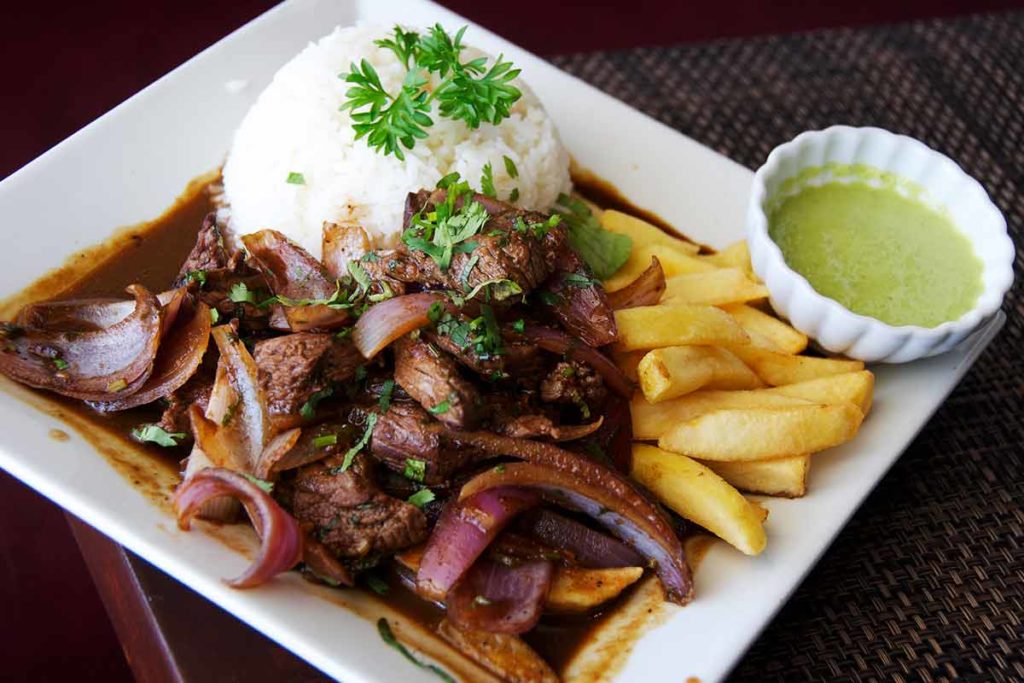
Lomo Saltado
Causa Limeña
The Causa Limeña is one of the typical dishes of Peru, very tasty and easy to prepare. There are theories where they point out that the cause is of Inca origin due to some historical data. According to them, our ancestors already had a «version» of the popular appetizer that we eat today.
On the other hand, various studies indicate that this dish dates from the year 1820, a period that coincides with the well-known Liberation Expedition of Peru, led by General José de San Martin for the independence of Peru.
With the initiative to better organize and support the Peruvian soldiers, the women began looking for ways to gather supplies and prepare Peruvian dishes to sell. The profit they obtained later would be used to buy medicine, clothing and food for the soldiers.
That was how the potato once again lived, the leading role. It was enough to be boiled, pressed and seasoned with some yellow pepper and salt to start selling them in the squares. The women of that time advertised their product under the slogan “Por la causa limeña or For the Lima cause” or “por la causa or for the cause”, referring to the struggle that was being waged at the time.
At present, we now have the option of enjoying a Causa Limeña as a starter, without a doubt one of the most historical and transcendental Peruvian dishes.

Causa limeña
Pachamanca
The Pachamanca is one of the most emblematic Peruvian dishes for all the meaning behind it. Today it is a Cultural Patrimony of the Nation, but before it was, it was an important offering to Mother Earth in Inca times.
Peru always enjoyed a rich gastronomy; From the beginning, different culinary techniques were used and, among them, we highlight the Pachamanca.
The Pachamanca is a ritual to mother earth in gratitude to the divinities of the Andean world for the good harvests of the season. From the 13th century, the Incas continued with the custom.
«Pacha» means «Earth» and «Manca» means pot. Its significance has been so important for the country that in 2003 the dish was declared a Cultural Heritage of the Nation.
With the passing of time, its preparation evolved and today we can all enjoy one of the most representative Peruvian dishes of the Andes.
How is the preparation of the Pachamanca?
Pachamanca is one of the Peruvian dishes that best represents its gastronomy, especially since it is an event where there is usually a group party. Normally it is prepared when there is a civic, religious, family festival, etc.
Of course, its preparation involves many people and each one has a specific role to play. On the other hand, the main ingredients do not usually vary.
To start making the Pachamanca, the first thing will be to dig a hole in the ground with a shovel or any tool that allows it. The idea is to create a kind of natural ‘oven’. Then, stones previously heated with firewood or charcoal are added to the hole to give way to cooking.
Once the space is suitable, different types of previously seasoned and marinated meat are added. Remember that the meats must be wrapped in banana leaves before putting them in the hole. Then you can add a wide variety of extras such as potatoes, sweet potatoes, broad beans and corn.
To close the hole and allow the Pachamanca to cook, it is necessary to do it with banana leaves, stones and earth, in this way we maintain the traditional way of preparation. The idea of this action is to concentrate the heat in the hole and achieve the necessary cooking of all the ingredients. The waiting time will vary between 40 to 90 minutes.
Once the Pachamanca is ready, place a cloak on the ground and serve it on different trays or plates and invite your loved ones to taste the rich traditional flavor of one of the Peruvian dishes with the most historical roots.

Pachamanca
If you want to see and be part of the whole Pachamanca process, visit the following link: Pachamanca Peruvian dishes
Pollo a la Brasa
Grilled Chicken is one of the Peruvian dishes that best represents the country’s mixed gastronomy. In fact, it is the most consumed dish in Peru.
History of Grilled Chicken
Despite being one of the most consumed Peruvian dishes, its history is relatively new. To date, it is known that the dish dates back to the year 1949 in the Chaclacayo district, specifically in Santa Clara – Lima.
It was all thanks to the ingenuity of Swiss immigrant Roger Schuler who, after carefully observing the techniques that his cook applied to chickens, began to test a particular cooking process on chicken.
He simply marinated the chicken with salt and left it to cook over charcoal on an iron rod. To his surprise, the result was juicy, golden meat with irresistibly crunchy skin. Realizing that said experiment was a success, he began to improve his technique with the help of Franz Ulrich.
Over the years, both would open a poultry shop, Ulrich being the missing piece for the business since he managed to design a totally customized oven, this one would include revolving iron bars to cross several chickens and achieve a semi-automated work.
The oven was named «El Rotombo» and over time, the partners added other seasonings in its preparation such as salt, pepper, cumin, rosemary, soy sauce, panca chili, among others.
The two entrepreneurs opened the first grilled chicken restaurant called «La Granja Azul» and which is still open to the public to this day.
As additional information, in 2004 the Ministry of Culture gave this dish the title of ‘Cultural Heritage of the Nation’.
Why is Grilled Chicken Day celebrated?
The celebration of Grilled Chicken Day is a tribute to the dish due to the importance it has for Peruvian gastronomy.
Thanks to the Ministry of Culture and its official establishment in 2010, we can enjoy every third Sunday of July as Grilled Chicken Day, promoting more and more the consumption of one of the tastiest Peruvian dishes in the gastronomy of this Andean country.

Pollo a la Brasa
As we already mentioned above, it is very difficult and unfair to make a list of only 5 Peruvian dishes that you cannot miss trying on your visit to Machu Picchu and Peru. However, it is a challenge that we set ourselves, since we also know that it will be very difficult for you to try the more than 150 typical Peruvian dishes from the 25 regions of one of the most megadiverse countries on the planet.
Due to this interesting problem we will add to this list, 2 Peruvian dishes from the Andes and the Peruvian Jungle that you cannot stop trying if you visit any of those regions.
Rocoto Relleno
When talking about stuffed rocoto, it is inevitable not to mention the Arequipa region in Peru, the place of origin of this Andean dish made from rocoto, a very spicy Peruvian chili pepper with a round shape and the size of an apple, whose name scientifically it is Capsicum pubescens. A fruit that is part of the long list of native chili peppers that Peru offers, such as yellow chili, panca chili, and limo chili, among others.
This emblematic Arequipa dish delights the most demanding palates in the world, due to its exquisite flavor, color and texture. Regarding its preparation, the veins and seeds are extracted from the rocoto to be filled with beef tenderloin, peanuts, chopped onion, raisins and cheese, in addition to being seasoned with spices such as pepper, huacatay, cumin and parsley. This dish is usually served with potato cake, another classic of Arequipa gastronomy and one of the most consumed Peruvian dishes in the department of Cerro de Pasco.

Rocoto Relleno
Tacacho con Cecina
The tacacho con cecina is one of the typical Peruvian dishes from the Amazon. The term «tacacho» probably derives from the Quechua «taka chu», which means «the hit».
The consumption of tacacho with cecina varies according to the region where it is made, so in Madre de Dios and San Martín it is customary to eat tacacho for breakfast while in other regions it is a dish served for lunch or dinner. In the San Martín region, the tacacho is included in the Christmas dinner.
Preparation
The dish usually consists of two balls of tacacho, one piece of cecina and one of chorizo; however, this proportion can vary at the diner’s request.
To make the tacacho, a dough made up of roasted green bellaco plantain, pork jerky or chorizo, oil, lard, and salt. Plantains have previously been roasted on charcoal, although in some regions, such as Huánuco, they are cooked in water. They are then fried with lard, pounded and shaped into two baseballs.
Separately, the cecina (dried and smoked pork) or the chorizo (or both) are prepared to accompany the tacacho. They are usually prepared on the grill. The cecina and chorizo made in the jungle of Peru include spices other than the traditional ones and therefore have a characteristic flavor, do not hesitate to try one of the most representative Peruvian dishes of its Amazon regions.

Tacacho con Cecina

You might also like






Leave A Reply